Freight pricing rules & terminology
This section explains key freight pricing concepts used in Proxio Rate Management, including rate sheet structures, weight calculations, units of measure, and pricing logic. It is intended to clarify terminology commonly used in transport and logistics rate management.
Written By Mattias Hägerstrand
Last updated 8 months ago
Units, Loading meters and Pallet spaces
Examples presented are relevant for Europe using the metric system.
About Units, Loading meters and Pallet spaces
Units is a shared parameter in Proxio. Depending on the design of the rate sheet, units will be used for different types of units. If the rate sheet catalog has one parcel rate sheet, one pallet rate sheet and one container rate sheet, the Unit parameter will be translated number of parcels, number of pallets and number of containers. Of course this implies that the rate sheet has one axis defined as a “Unit” axis in the imported price matrix.
If there is a pallet rate sheet which quantifies the price from number of pallets you need to use Units for the number of pallets. The same goes for containers.
If there is a weight-based rate sheet which has pay-weight as price quantifier both loading meter, pallet spaces and volume can be used to calculate the pay-weight (by conversion factors) which then will be used to extract the price from the price matrix.
Pallet spaces is a specific parameter for rate sheets which has number of pallet spaces as cost quantifier. It can also be used if the rate sheet has Loading meter as cost quantifier, if the rate sheet at the same time has a conversion factor from pallet space to loading meter.
A loading meter is a standard unit of measurement used to calculate the size of goods that cannot be stacked within a truck. 1 pallet space equals 0,4 loading meters. One loading meter equals 1 meter of the total space of the length of a truck. Loading meter is usually used when non-stackable goods are shipped. Often it gets converted to pay-weight for calculation against a weight-based rate sheet.
Add-ons
An add-on is an extra service that the customer can choose to add when booking the shipment. In contrast to Surcharges, that the customer does not have direct control over.
Examples of add-ons:
Notifications by SMS and/or mail
Carry-in
Dangerous goods
Cargo insurance
Express
Advantage calculation
Advantage calculation is relevant for weight-based rate sheets where the price unit is also weight-based (e.g. price per kg). This is typically used for shipments where the freight weight exceeds the normal groupage/bulk breakpoints. Without advantage calculation, the total shipment cost may become higher for some weight ranges than for a heavier shipment.
Example: A rate sheet has weight intervals 1–10 kg, 10–20 kg, 20–30 kg, and the price is calculated per kg.
If the price per kg is:
10–20 kg: 2.00 EUR/kg
20–30 kg: 1.60 EUR/kg
then a shipment weighing 19 kg would cost:
19 × 2.00 = 38 EUR
while pricing it as 20 kg (next interval) would cost:
20 × 1.60 = 32 EUR
Meaning it becomes cheaper to ship 20 kg than 19 kg, creating a “saw-tooth” effect in the price curve. Advantage calculation removes this effect by cutting the “saw teeth”.
Carrier
A Carrier is the company providing the transport service, responsible for moving goods from origin to destination. Examples of carriers include DSV, DHL, Schenker or PostNord.
Carrier service or Transport Product
A Carrier Service (also called Transport Product) is a specific transport service offered by a carrier. It defines the service level and conditions, such as lead time, delivery type, and network.
Examples include: DHL Express Worldwide, DSV Road Groupage or PostNord MyPack Collect
Carrier services are often used in Proxio to structure rate sheets and ensure correct pricing based on the selected transport product.The service provided by the carrier. For example DHL Express Worldwide
Chargeable weight
If the carrier would charge for actual weight, the carrier might lose money if the customer fills the truck with cargo that takes up much space but does not weigh much. If the carrier would instead charge for only volume, the customer could max out the trucks weight limit with cargo that does not take up much space. The solution is to convert volume to "chargeable weight", using a conversion factor, and then charge the customer for the weight that is highest (actual or chargeable). It's not only volume that can be converted to chargeable weight, pallet spaces and loading meter can also be converted.
Drayage charge
The cost associated with the movement of shipments over a short distance that may be from a warehouse/rail terminal to the port or vice versa. This movement usually happens via trucking services.
Freight amount
Specifies the size/weight of the shipment. Examples of freight amount units: dimensions, volume, weight, loading meter, parcels, pallets, pallet spaces, cargo containers. Which unit that is used depends on the nature of what is being transported. The carrier will usually charge using the unit that is most beneficial for them.
Full Container Load (FCL)
In an FCL cargo, the complete goods in the said container is owned by one shipper. See also Less Container Load (LCL).
Less Container Load (LCL)
If a shipper does not have enough goods to accommodate in a fully loaded container, he arrange with a consolidator to book his cargo in an LCL shipment.
Full Truck Load (FTL)
A full tThe number of meters of the length of a standard truck bed that is required by the shipment. It means a shipment that uses an entire truck, either because;
the cargo fills the truck (by weight or volume), or
the customer books the whole truck exclusively (even if it’s not completely full)
Key characteristics of FTL transport
One shipment (or one customer) per truck
Typically goes directly from pickup to delivery with no terminal consolidation
Faster lead times compared to groupage/LTL
Pricing is often based on lane + truck type, rather than per kg
Loading meter
The number of meters of the length of a standard truck bed that is required by the shipment. For example, two pallets uses 0.8 loading meters.
Pallet
Pallets are used for easier lifting of goods. There are several types of pallets, but the EUR-pallet is a most common reusable pallet in Sweden.
Other dimensions on pallets are available internationally and in Sweden .
The physical pallet is associated with a cost. Unlike a container, it has no clear owner. Instead, pallets are exchanged between shipping customers. Transporters often have a pallet transfer system for EU pallets where they find out a balance and can invoice/replace pallet differences.
Pallet spaces
The area on the truck bed that is required for one EUR-pallet is one pallet space. Since some pallets can be stacked on top of each other, the number of pallets that can fit on a truck is not always the same as the number of pallet spaces on the truck.
Relation based rate sheets
A rate sheet where one axis contains both origin and destination places. In contrast to zone based rate sheets, which has either the origin zones or the destination zones on one axes, or origin and destination on separate axes.
Surcharge
A surcharge is a fee that is added by the carrier as compensation for extra cost due caused by the customer, for external factors etc.
Examples of surcharges:
Fee for shipments to big cities, islands without bridges, and remote or dangerous areas
If the package could not be delivered because the customer was not home
If the cargo was larger or heavier than is allowed for the service
Fuel surcharges. Varies with oil prices, most often monthly updates.
Road tax
Environment tax for sulphur emission from ships (Marpol)
Rate sheet /Tariff / Price list / Contract
A list of prices a carrier will charge for shipments, usually varying depending on freight amount and how far or where it should be transported. Also specifies additional cost that can be applied depending on the nature of the shipped goods, where/when/how it is being transported or what extra service the customer chooses.
Twenty-foot Equivalent Unit (TEU)
A TEU is a measure of volume in units of 20-foot long containers. A 40-foot container equals 2 TEU’s.
Weight or Measurement (W/M)
Same concept as "chargeable weight", where either the weight or the measurements of the shipment is used to calculate the price, depending of which results in the highest price. Is used for sea and air freight.
For sea freight: Price per metric ton or per cubic meter, whichever is greater.
For air freight: Price per kilogram or per 7,000 cubic centimeters (1 cubic foot) whichever is greater.
Facade rates
[VALIDATE]
A Facade is a customer-facing presentation layer used to simplify rate structures. It groups and hides complex internal pricing logic and makes the prices easier to understand for the end user (For example someone using the Rate Calculator)
In practice, a facade can be used to present one “product” or “price package” to the customer, even if the calculation behind it includes multiple rate sheets, rules, markups and cost components.
Merge tariffs
Sometime a price structure for a Relation A->B is complex. For example if we have a relation A->B which consists of three separate price lists: Leg A (truck), Leg B (train) and Leg C (truck).
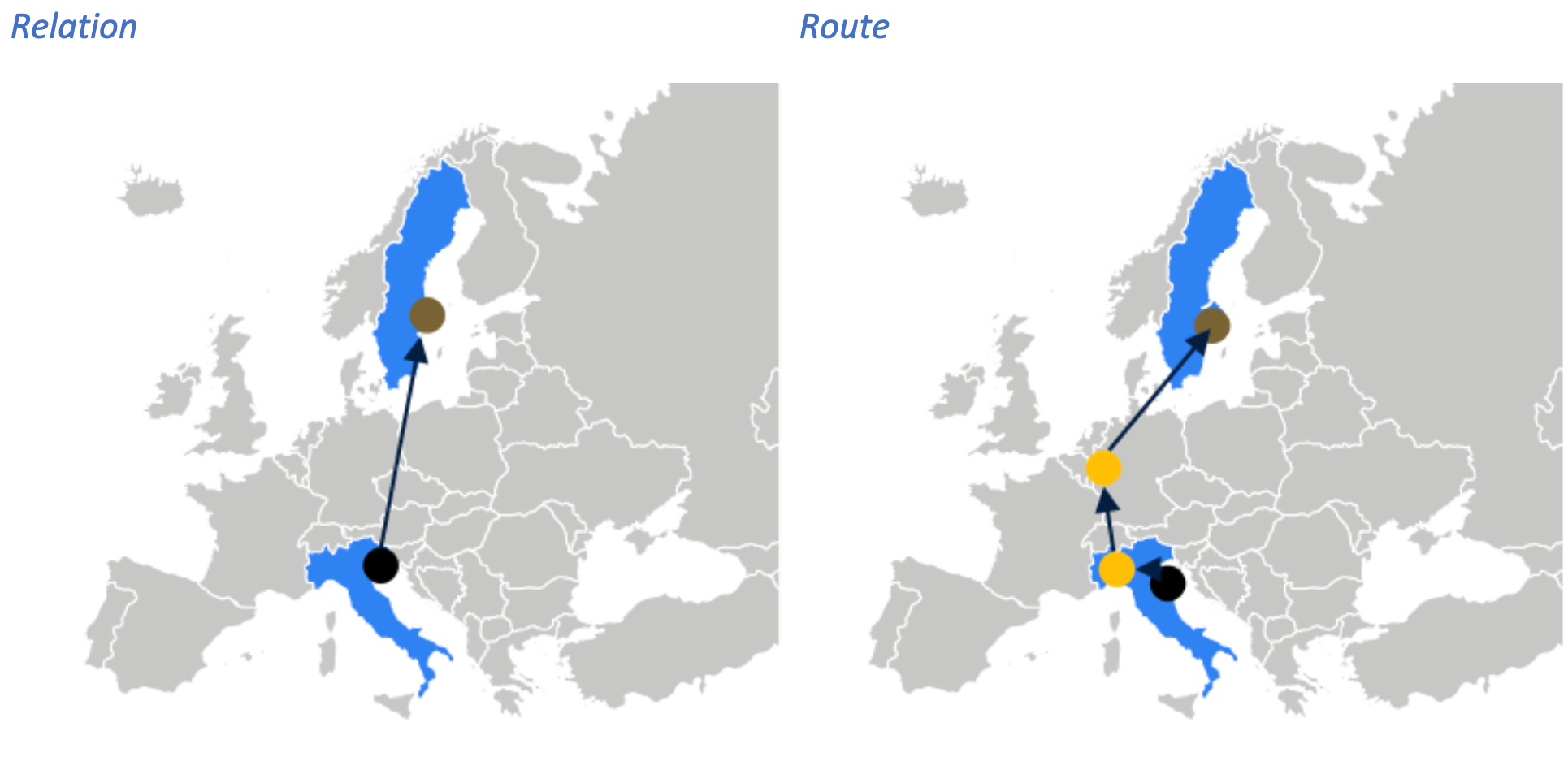
The system can handle this scenario by creating a separate rate sheets for each leg. If we do this we will have 3 rate sheets covering the 3 different legs.
When the system (via Rate Calculator or via API) gets a price query from A → B, we want the system to combine the three prices for the three legs. To accomplish this, we need to merge the tariffs and choose the merge option “Multiple legs”. In the wizard we must configure the address for the route points (see yellow dots in picture).
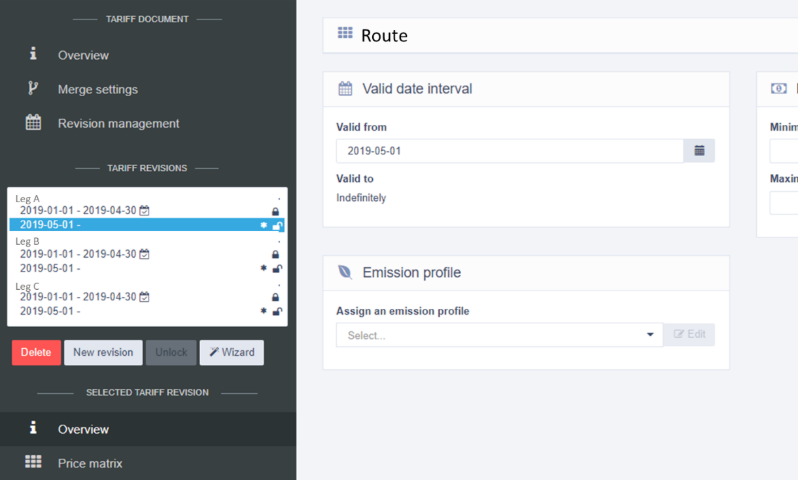
In the user interface, the merged Rate sheets will be illustrated like this:
Carrier service templates
[VERIFY so that we don’t write this in several places, see Carrier Service above]
Fussy matching
Partial postal codes
User defined distance
Support for custom user defined data
Match shipments with tags
Match shipments with Keys
What kind of built in validations does the system provide
Different ways of calculating in the system
Postal code formats handled by the system
How payweight is calculated
[See chargeweight above]
How does a freight cost price list work
Still need help? Share an idea